MILELE EXPEDITION / WILDLIFE
Great Wildebeest Migration Month by Month: Where the Herds Are, From Our Guides
The question we hear most over breakfast in Arusha is simple: "Where are the wildebeest right now?" Fair question. The herds never sit still, and a lodge in the wrong corner of the Serengeti can mean a week of beautiful empty plains.
Ask Milele to plan my tripSo here is how we brief our own guests. Month by month, area by area, with the honest caveat that rain decides everything.
The short answer
The herds calve in the southern Serengeti and Ndutu from December to March. They move north-west through the Western Corridor from April to July, cross the Mara River in the north from July to October, and head south again in November. Rain decides the exact timing.
How big is the migration, really?
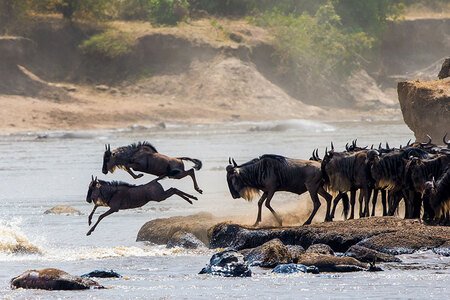
The numbers are hard to picture until you're sitting in a vehicle surrounded by grunting animals on every side.
The Tanzania Wildlife Research Institute's 2023 aerial census counted the herds on the southern short-grass plains at the end of March 2023. Their estimate was 1,366,109 wildebeest, give or take about 230,000. In 1955 the count was around 190,000. The population has grown to over a million since the late 1970s.
Add hundreds of thousands of zebra and gazelle, and you start to understand why the Serengeti was inscribed as a UNESCO World Heritage Site in 1981.
The whole loop runs through the Serengeti, the Ngorongoro Conservation Area and Kenya's Maasai Mara. It is a circle, not a line. There is no start and no finish.
The migration at a glance
December - March
Where the herds usually are: Southern Serengeti and Ndutu (Ngorongoro Conservation Area)
What you'll see: Calving, big predator action, green plains
Our tip: Base yourself around Ndutu
April - May
Where the herds usually are: Moving north-west through central Serengeti
What you'll see: Long rains, lush grass, fewer vehicles
Our tip: Good value, muddy roads
June - July
Where the herds usually are: Western Corridor, Grumeti River
What you'll see: Herds bunching, first river crossings
Our tip: Flexible routes pay off
July - October
Where the herds usually are: Northern Serengeti, Mara River
What you'll see: Dramatic crossings at Kogatende
Our tip: Book northern camps early
November
Where the herds usually are: Moving south down the eastern side
What you'll see: Short rains, herds strung out on the move
Our tip: Central Serengeti works well
December to March: calving season in the south
This is our favourite time, if we're honest.
When the short rains arrive, the herds pour onto the short-grass plains of the southern Serengeti and the Ndutu area. That area sits inside the Ngorongoro Conservation Area, not the national park. It matters for your permits and your fees.
The grass here grows on volcanic soil rich in minerals. Pregnant females need that. Most calves are born in a short window, usually around February, and they're on their feet within minutes.
What calving season looks like on the ground
• Huge herds spread to the horizon, often within a short drive of camp.
• Lions, cheetahs and hyenas hunting in the open, because newborns make easy targets.
• Afternoon thunderstorms that roll in fast and clear just as quickly.
• Green plains, wildflowers and good light for photography.
If you want predators, this is the season. You won't see river crossings, but you'll see things that are just as raw.
April and May: the long rains
The herds start drifting north-west as the southern plains dry and the long rains set in.
This is low season. Lodges drop their rates, and the park conservation fees drop too between mid-March and mid-May. Some camps close. Roads around the black-cotton soil can turn to grease.
We still run trips in April and May. The landscape is the greenest you'll ever see it, and you'll often have a sighting to yourself. Just pack a rain jacket and expect the odd detour.
June and July: the Western Corridor
By June, the bulk of the herds are usually funnelling into the Western Corridor. The Grumeti River is the first real barrier.
The Grumeti doesn't flow strongly at this time of year. It's more a chain of pools and channels. That doesn't make it safer for the wildebeest. Some of the largest crocodiles in the ecosystem live here.
Mornings get properly cold from June. On game drives we tell guests to bring a fleece and a light down jacket, then peel them off by 10 a.m.
July to October: the Mara River crossings
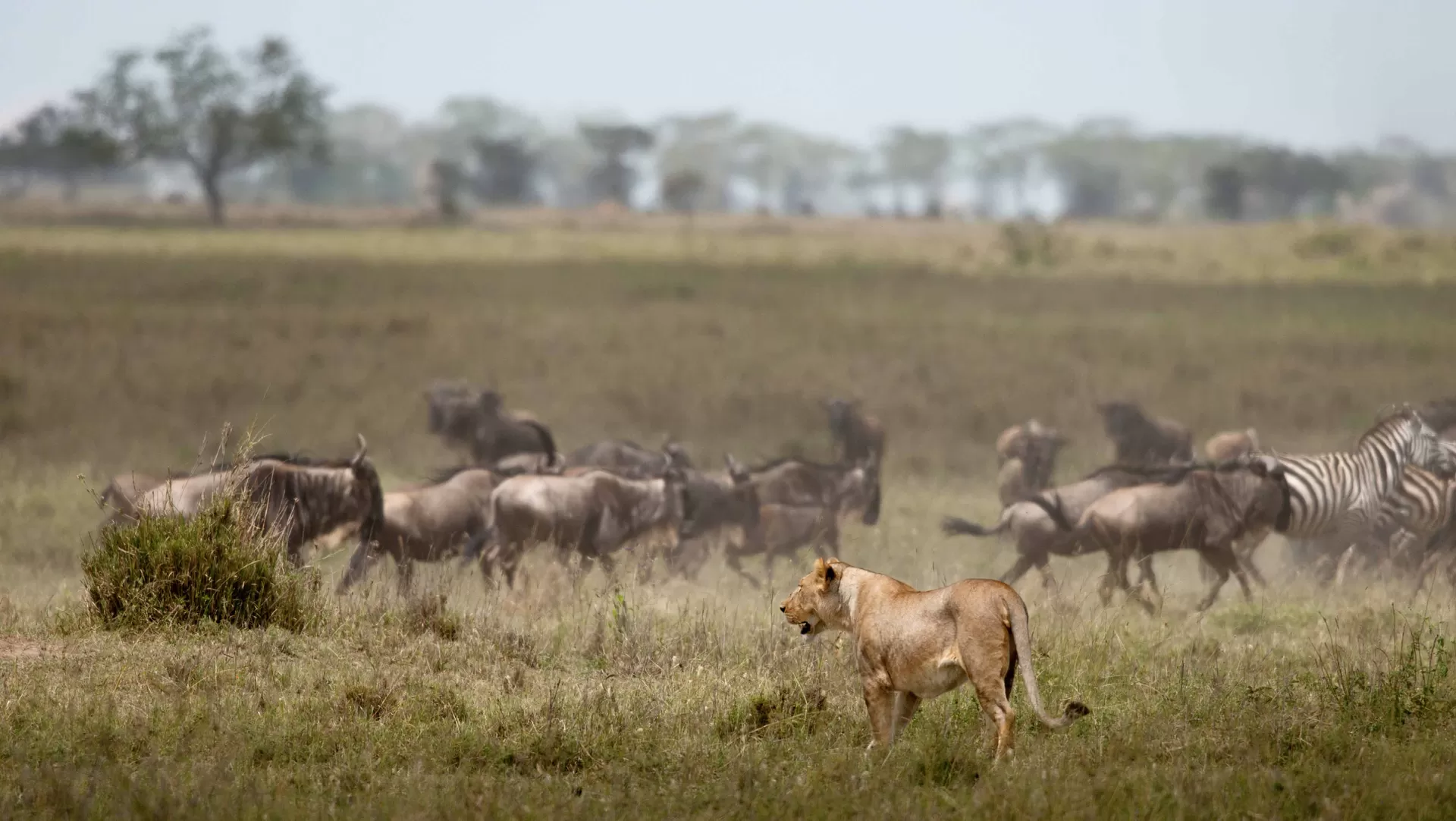
This is the scene on every documentary, and it's why the northern Serengeti fills up in August.
Herds gather on the banks of the Mara River around Kogatende. They mill about, sometimes for hours. Then one animal commits, and thousands follow.
Honest advice about crossings
• Patience matters more than luck. Crossings can happen any time of day. Some days, none happen at all.
• Stay back from the banks. Rangers enforce viewing rules, and crowding the crossing points can turn the herd away.
• Book early. Northern camps are small and fill months ahead for August and September.
• The herds cross back and forth. Animals move between Tanzania and Kenya several times, so "missing it" is rarely final.
November: heading south again
When the short rains return, the herds turn and head south down the eastern side of the park, through areas like Lobo and central Serengeti.
It's a transition month. Animals are on the move and spread out. Central Serengeti, around Seronera, is a smart base because it keeps you within reach whichever way they go.
Why "on average" is the most important phrase here
Every migration map, including ours, is an average. A late rainy season can push calving weeks later. A dry spell can send the herds north early.
The Tanzania National Parks Serengeti page covers the park's geography and access if you want to understand the regions before you choose a camp.
When we plan a migration safari, we look at three things:
1. Where the rains have fallen in the last few weeks. The herds follow fresh grass.
2. What other guides are reporting. Our drivers share sightings every evening.
3. How flexible the itinerary is. A mobile camp or a central lodge beats a fixed location in the wrong region.
How many days do you need?
For calving season, three full days in the Ndutu and southern Serengeti area gives you a real chance at a hunt.
For river crossings, plan at least three nights in the north. Fewer than that and you're gambling on one or two days of waiting at the banks.
If you're short on time, a shorter Serengeti trip from Arusha can still put you among big herds in the right months. Have a look at our Tanzania safari itineraries and we'll match the route to your travel dates.
Quick checklist before you book
• Match your month to the region in the table above.
• Check whether your camp is inside the national park or the Ngorongoro Conservation Area, since the fees differ.
• Ask how far your lodge is from the current herd location, not last year's.
• Pack layers for June-October mornings and a rain shell for November-May.
• Allow a buffer day if crossings are your main goal.
For a broader view of seasons across the country, our best time to visit Tanzania guide covers rain, temperatures and park-by-park conditions.
A closing tip from the guide's seat
Don't spend the whole trip chasing a crossing. Some of our best migration days have been quiet ones: parked among grazing herds at sunrise, engine off, just listening to them call. The drama is wonderful. The scale of it, felt from the middle, is what guests remember.
Plan your trip with Milele
Tell us your dates, group size and what you most want to see. Our Arusha team will reply with a clear, itemised plan, with no payment needed to ask.
Ask Milele to plan my trip